Categories
Here’s an updated version of this article: Google Ads for B2B: how to reduce wasted spend from consumer traffic
B2B (business-to-business) companies often struggle with quality score and ad writing. They want to target a specific audience, but often compete against B2C companies for the same keywords.
For instance, take the term ‘safety gates’.
The most common searcher for this term is a consumer looking for a pet or child safety gate. These gates often sell for under $50.
However, some of these searchers aren’t looking for $50 gates. They’re looking for gates for industrial factories and plants, which cost $5,000+.
There’s no way to designate your keywords for a B2B or B2C searcher.
These two types of companies are competing for impressions, but not for clicks.
The B2B companies don’t want the clicks from the B2C companies and vice versa.
So how do B2B companies manage these search terms when they don’t know if the searcher is a parent or a purchasing agent?
Prequalifying users via ads
Just take a look at these ad results. The blue highlight is B2B ads and the green highlight is B2C ads.
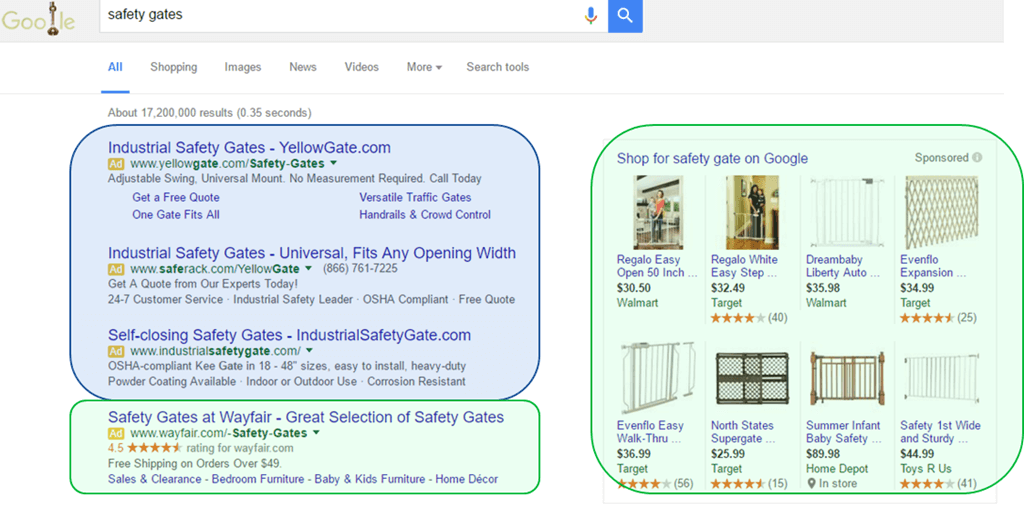
What these B2B companies are doing correctly is prequalifying users. They’re calling out the gates are industrial with terms such as:
- OSHA compliant
- Crowd control
- Industrial
- Get a quote (instead of listing prices)
In this case, the ad copy helps ensure that B2C searchers won’t click on the ads while appealing to B2B searchers.
Many B2B companies benefit from testing templates or multi-ad group testing to see which ads attract the correct clicks. In other words, clicks that convert with a decent conversion per impression.
Prequalified ads lead to lower quality scores
When you prequalify users, you end up with lower CTRs. This in turns lowers your quality score.
That isn’t necessarily a bad thing. Quality score is a metric, not a KPI. Higher quality scores are useful if your conversion rates stays static or goes up. You shouldn’t raise your quality score if it lowers your conversion rates.
This is one B2B company’s stats on conversion rates by quality score for non-branded terms:
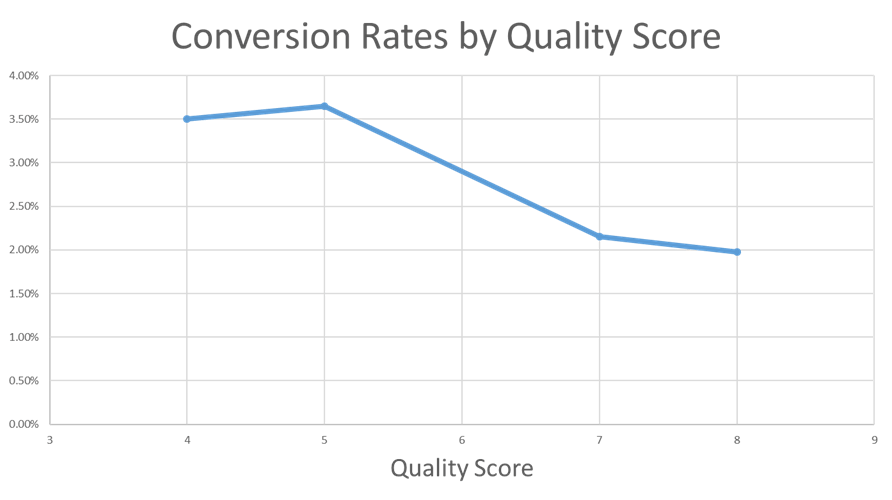
The lower their quality score, the higher their conversion rates.
The ‘safety gate’ companies could easily raise their CTRs by removing the words ‘industrial’ from their ads. However, their conversion rates would suffer and their CPAs would increase.
This quality score to conversion rate trend isn’t always true. If you have poor organization and bad ads, you might see lower conversion rates at lower quality scores.
B2C companies can often raise CTRs and quality scores without sacrificing conversion rates. It just takes good organization and ad testing.
For B2B companies, the focus should be ensuring your quality scores are at least 4-5 on terms that are searched by both consumers and businesses. When your quality scores drop below 4-5, you often see a dramatic drop in impression share. It’s useful to keep an eye on quality score to ensure your ads are showing.
Of course, if the search terms are primarily conducted by B2B searchers, you should see much higher quality scores. The same goes for brand terms.
Wrap-up
Writing ads isn’t about getting the most clicks. It’s about getting the correct clicks.
That’s why we’re such fans of conversion per impression and revenue per impression metrics. They focus on both CTR and conversion data, which helps both quality score and conversions.
In B2B, focusing on the correct clicks means watching which keywords are searched for by both B2B and B2C. And then weeding out the B2C searchers with benefits that appeal to only B2B searchers.
Share around the web






Improve performance
with
actionable
analysis


Leave a comment