Google Ads for B2B: how to reduce wasted spend from consumer traffic
By Brad | 0 comments May 28, 2026
Categories
Most commercial search queries come from consumers, not businesses. That makes Google Ads for B2B harder than many advertisers expect. Even when search volume looks strong, a large percentage of clicks may come from people who will never become customers.
B2B advertisers face a double challenge: finding enough qualified search volume while avoiding wasted spend on consumer traffic.
In this article, we’ll share how to improve the quality of paid search traffic for your B2B accounts.
Classify your keywords
In B2B, search volume can be deceptive. A search for ‘accountant’ could come from a consumer or a business owner.
On the other hand, a search for CRM software is very likely to come from a business buyer. In general, most jargon will only be searched for by procurement teams.
The easiest way to classify your keywords is to upload your keyword list to an LLM. Ask it to group terms by likely search intent. Then, double-check the list for mistakes.
We can use this information in two ways:
Should we use the keyword?
If the search is primarily B2B, we should use the keyword. We also don’t need to worry about prequalifying the searcher.
Many keywords will sit in the middle, attracting both businesses and consumers. In this case, we need to prequalify the searcher with our ad copy.
We only want keywords searched for mostly by consumers if we have budget left. Fully funding our business keywords is the priority.
Do we need prequalification?
Ad copy can act as a filter. The goal is to write ads that are attractive to businesses while discouraging consumers.
If the searchers are mostly businesses, then we can skip prequalification and focus on benefits/CTAs. We can also use jargon in these ads since the searchers should understand the industry.
However, you must watch your search terms. Just because your keywords are B2B-focused doesn’t mean all your search terms will be. Adding negative keywords is essential.
Prequalify users with your ad copy
B2B ad copy should make it clear who you’re targeting. It should also discourage consumers from clicking, since the ads should look irrelevant to them.
Here are some examples:
- For teams of 100+
- Business accountants
- Starting at $3000 per month
- Bulk pricing for 1000+ nails
This search for ‘safety gates’ reveals two very different ads. The first is for child safety and safety gates for use at home. The second ad has sitelinks like ‘request a quote’ and the word ‘industrial’ signals it’s for companies.
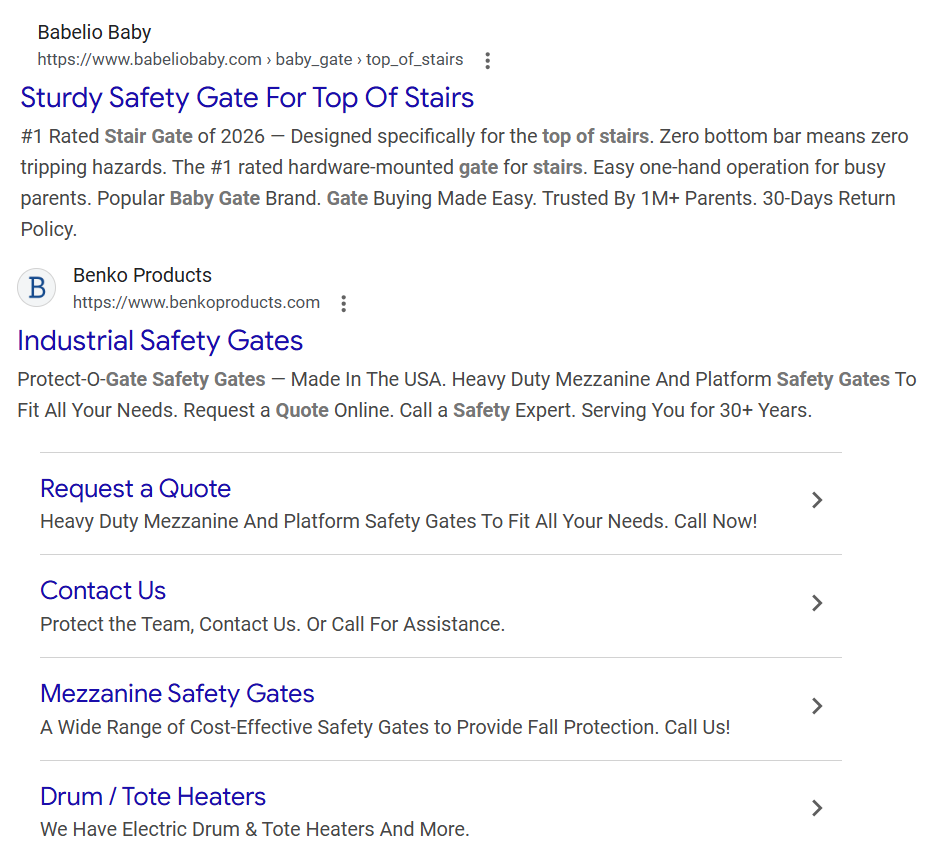
When you prequalify users, your CTR will drop. That’s OK. The goal isn’t to get every click possible, but to pay only for clicks from the right audience.
Accept low quality scores
Prequalifying users means a lower CTR. This will decrease your quality score. That’s fine when it’s low quality scores for keywords that attract consumer searches.
For instance, when this account’s quality score goes above 5, conversion rates start to drop.
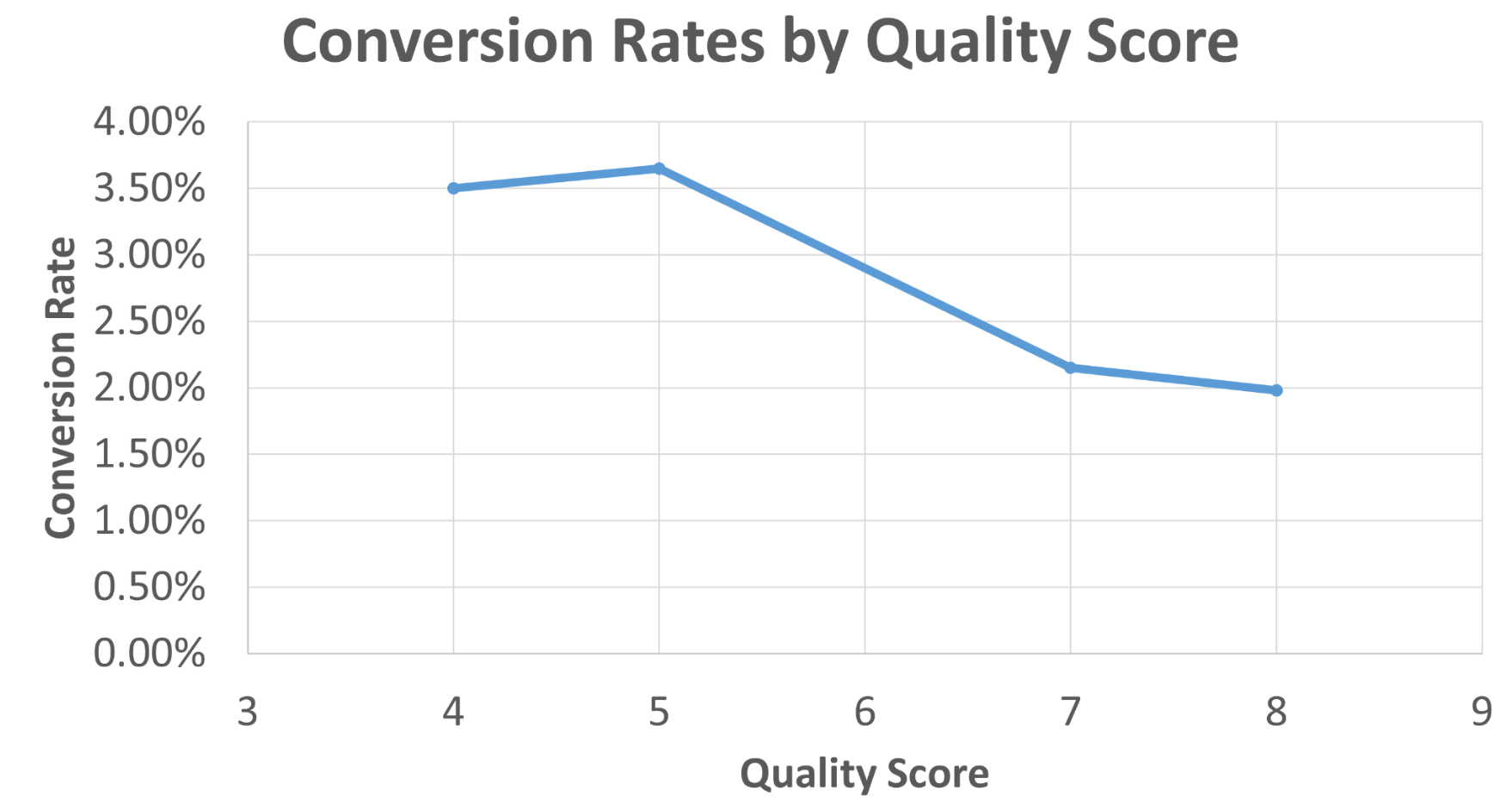
They could raise their quality scores by removing the prequalifying statements. However, that change will increase the number of consumer clicks they receive. The result is likely to be higher CPAs and lower conversion rates.
When we think of B2B keywords, here’s the rough guideline for quality score:
- B2B only search terms: 7+
- B2B & B2C search terms: 5
- Primarily B2C search terms: 4
Track offline conversions & calls
Most B2B sales don’t happen online. They happen over Zoom calls, DocuSign contracts, and phone calls.
If you’re only tracking form fills, you’re giving equal weight to qualified and spam leads. Pass conversions to Google as far down the funnel as you can. Better conversion tracking helps you and your bid strategy make good decisions.
Marketing qualified leads (MQLs), sales qualified leads (SQLs), or final sales (revenue) are essential for optimizing B2B accounts.
Long sale cycles
The biggest issue with offline conversion tracking for bidding is the long sales cycle. It can take months for a B2B deal to close. By the time you can import revenue, the data is so old that Google won’t use it for bidding and targeting.
Offline conversions and CRM integration are still important. However, B2B advertisers usually need more recent conversion signals for bidding. Balancing data recency and overall conversion volume helps bid strategies work effectively.
Obviously, sales and revenue are our best conversion signals. However, with long sales cycles and low volume, we need to find middle ground for bidding and optimization.
Examine how many leads, MQLs, SQLs, and sales the company receives in a 30-day window. If you have other conversions, such as PDF downloads, calls, demos, etc, you can also use that data to help the bid system.
The ultimate goal is to reach at least 15 conversions per month. (Although bid systems perform better with 30+ conversions.) If you don’t have enough sales, look at which additional conversions you can add.
Avoid form fills and only include lead scoring or verification. This will help prevent non-qualified leads from sending signals back to Google.
Analyze your n-grams
Many B2B accounts have low search volume. That means it’s hard to spot when a set of search terms isn’t performing well.
N-grams break your search terms down into phrases and then aggregate your data by phrase. That helps you spot when Google matches your keywords to similar words from a consumer context.
For instance, Google often interchanges these phrases:
- How much
- Average price
- Quote
Many B2B companies do quite well when the search term includes the word ‘quote’. But when someone asks for the average price of something or how much a product costs? They’re still researching and generally not ready to contact a company. Therefore, you should treat these search terms differently.
N-gram analysis helps you to find types of trends.
Check your PMax search terms
PMax has mixed results for B2B Google Ads accounts. The biggest issues are B2C search terms and search term cannibalization.
To prevent your ads from appearing in consumer searches, regularly review your PMax search terms. And liberally use negative keywords. N-gram analysis is also helpful, as PMax trends will be different from Search.
The second issue is one that all advertisers face: PMax stealing impressions from your Search keywords. When the same search term triggers an ad from Search versus PMax, the Search campaign has a higher conversion rate 84% of the time.
PMax can be a good source of backfill. It can find gaps in your keyword coverage and serve across other channels. However, don’t let it take impressions from your well-crafted Search campaigns.
Our article on PMax search term cannibalization goes into detail.
Check your AI Max search terms
There are two issues that most B2B companies face with AI Max:
All of your keywords are treated as broad match, so they can show for related search terms. This often leads to your ads appearing for consumer searches.
It’s important to regularly review your search terms. Since many B2B companies have low search volume, n-gram analysis can help you spot trends.
Text customization often creates assets with high CTRs, but without prequalifying users. Our article on creating message restrictions shows how to help Google create effective assets for your B2B offer.
You should also consider pinning your prequalification assets to your headline 2 position. This will ensure that your ads continue to prequalify users.
Wrap-up
B2B Google Ads accounts face challenges that consumer accounts don’t. Your first line of defense against wasted budget is focusing on B2B keywords and using negatives to stop your ads from showing on B2C searches.
Next, make sure your ads attract the right audience by prequalifying users. Ads that dissuade consumers and appeal to business searchers will save you money and increase your conversion rates.
Once your campaigns are live, optimization depends on trustworthy conversion data. Offline conversion tracking helps you optimize toward qualified leads and sales instead of form fills. However, long B2B sales cycles mean you may need to balance lead quality with enough recent data for bidding systems to learn effectively.
It’s also important to understand how automation affects your account and put guardrails in place. That can range from AI Max messaging restrictions to monitoring PMax search terms for cannibalization.
By following these guidelines, you can reduce wasted spend, improve lead quality, and make sure your campaigns are reaching business buyers, not consumer traffic.
Share around the web





Improve performance
with
actionable
analysis


Leave a comment