Categories
When you work in ecommerce, the name of the game is ROAS (or ROI, depending on your definitions). You deal in margins, hard costs, and you need to ensure that your bidding and testing is accounting for these margins.
However, there are times when ROAS fails, and I want to take you through a story of why this happens.
Implementing ROAS bidding
I was working with an ecommerce account who was doing ‘ad hoc’ bidding. They bid based on what they felt a keyword was worth, they ran the numbers at random intervals, and didn’t have a great bidding strategy in place.
The boss decided that they needed a target ROAS and should bid on hard numbers. The PPC team built a nice spreadsheet to manage the bids based on a target ROAS and implemented the new strategy.
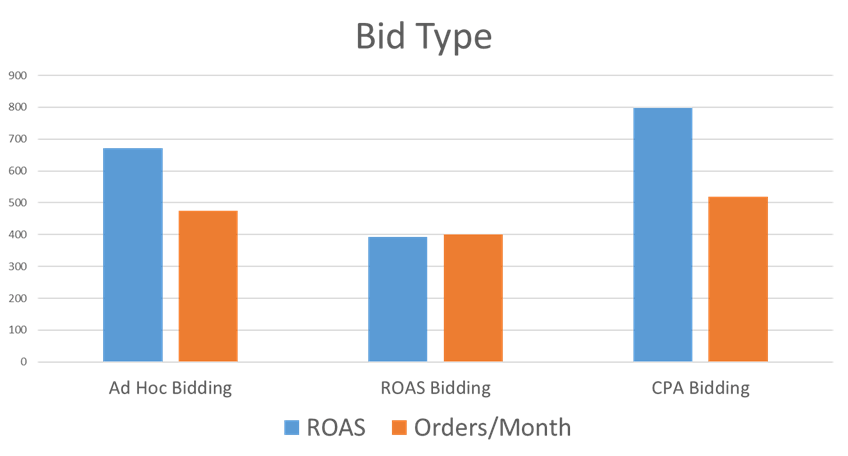
The very first month of this new strategy, they knew something was wrong as their ROAS and orders dropped:

They started analyzing the data and found it hard to figure out what was happening. It all seemed so random — and that was the actual problem.
How random is your data?
ROAS bidding is based on predictability. While a keyword’s value might slightly increase or decrease each day or week, outside of holidays or peak days, ROAS bidding & testing is based on an overall idea of an item’s worth and contribution to the bottom line.
However, sometimes that’s not true. That’s when you can get into trouble with ROAS bidding & testing.
This company’s average sale is roughly $500. However, they get a few high value orders each month which are over $10,000. These larger orders make a huge difference to their overall profits. When you consider ROAS bidding, this is what was happening (numbers rounded for easier understanding):
- Week 1: Keyword had 38 clicks and 2 sales for $938. Based on click costs and target ROAS, the bid could be set around $5.
- Week 2: Keyword has 41 clicks and 1 sale for $10,103. Based on their targets, the keyword could be bid over $100, however, they had a $10 bid cap on any one keyword.
- Week 3: Keyword has 56 clicks and 3 sales for $872. Now the click costs need to be reduced to under $3.
Having the same keyword’s bid go from $5 to $10 to $3 has a large change on its average position, how many clicks it can drive, and changes its impression share dramatically.
Now, if this were just one keyword, it might not be a big deal. If this type of issue is common for the entire account, then we can see why ROAS bidding might fail.
When we examine the orders for predictability (as ROAS bidding is predicated on predictability), this is what we see:

This chart shows that 87 different keywords drove 102 sales of over $10,000. As the number of sales is almost equal to the number of keywords, there’s no predictability among these larger orders.
For orders under $500, their 4502 orders came from only 245 keywords. That means small sales are somewhat predictable.
When you take a look at the numbers, you can’t bid ROAS for the high orders, although you could for the small ones. However, if you bid by ROAS for the small orders, then you remove your high value items (and 102 10,000+ orders are over $1 million in revenue and the small orders are $1.3 million in revenue; they are close in total value).
So how do you handle non-predictable ecommerce bidding?
Enter CPA bidding
Their goal is to get the most orders possible, with reasonable margins. Some of the orders will be high value and others will be lower, but the aggregate amounts will hit their overall revenue goals.
They scrapped their bid model completely.
They looked at each product group, calculated the average order, the total value, and their margins on these products. They then determined a CPA for each product group. Some of their ad groups sell one product group, so it was easy to set the CPA target. Other ad groups could sell multiple product groups so they had to use a blended CPA.
Once they had this information, they switched to using Google Ads CPA bidding and let Google’s system set the bids based on their overall targets. Within a month, they’d found a bid system that would accommodate their random large orders.
Now that bidding was taken care of, it was time to turn to ad testing.
CPA vs CPI ad testing
Their previous ad testing had revolved around choosing the highest RPI (revenue per impression) ad and using the ROAS as a tie breaker.
However, now that they were using a different bid model and mindset, they changed how they test their ads. Instead of focusing on revenue, their goal is to get the most conversions possible under a specific CPA.
They turned to conversion per impression ad testing and used CPA as a filter.
For instance, if this were their data, they would look and say that ad 3 has the highest CPI. Is it underneath our target CPA? If yes, then it’s a winner. If it’s above our target CPA, then what ad has the highest CPI and is under our target CPA? That would be the winner.

Wrap-up
ROAS or ROI bidding is often a great bid method for variable checkout amounts when you have predictable information. However, it does a terrible job of accounting for the randomness of orders or average order values.
When you’re dealing with non-predicable data, instead of trying to control every margin (and thus lose some sales); it is worth testing CPA bidding and CPI ad testing to see if that has a positive effect on your total revenue.
Share around the web





Improve performance
with
actionable
analysis


Leave a comment