Categories
This week, we’re featuring everything you need to know about conversion rate testing.
This metric is commonly used for testing. The higher your conversion rate, the more conversions you have once someone clicks on your ad.
The biggest downside of conversion rate is that it doesn’t take into account how many clicks your ad actually receives.
What is conversion rate?
Conversion rate (CR) is simply the ratio of clicks to conversions.
How conversion rate is calculated
Conversion rate is calculated by dividing the number of conversions by your clicks:
CR = conversions/clicks
It’s generally displayed as a percentage. Here are some examples:
| Ad | Conversions | Clicks | CR |
| 1 | 1 | 100 | 1% |
| 2 | 10 | 100 | 10% |
| 3 | 32 | 1045 | 3.06% |
| 4 | 57 | 1103 | 5.17% |
In this case, ad 2 has the highest conversion rate and ad 1 has the lowest.
The advantage of using CR as your testing metric
There are two main reasons to use CR as your testing metric:
- Get the most conversions possible once you get the click
- Use ads to test landing pages
A common landing page testing method is to use two identical ads in an ad group with different destination URLs. A 1 goes to landing page 1 and ad 2 goes to landing page 2.
If you are testing page templates, then you might duplicate this test across several ad group and use multi-ad group testing to aggregate the results across all of your ad groups.
The other reason to use conversion rate as a testing metric is when you want the most conversions possible once someone clicks on your ad. We have to qualify this very carefully as conversion rate has an inherit weakness – it doesn’t care about the volume of clicks.
The disadvantage of using conversion rate as your testing metric
While conversion rate is great for landing page testing, it’s not a good metric to use for increasing total conversions from your PPC ads. (See inside the ad testing metrics CTR for more on click through rate). Consider these stats:
| Ad | Impressions | Clicks | Conversions | Cost | CTR | Conv Rate | CPA |
| 1 | 1000 | 100 | 10 | $200 | 10% | 10% | $20 |
| 2 | 1000 | 10 | 2 | $25 | 1% | 20% | $12.50 |
| 3 | 1000 | 56 | 5 | $126 | 5.6% | 8.93% | $25.20 |
| 4 | 1000 | 11 | 4 | $33 | 1.1% | 36.36% | $8.25 |
| 5 | 1000 | 156 | 12 | $234 | 15.6% | 7.69% | $19.50 |
In every case, these ads all received the exact same impressions. Because CTR varies, so will the actual CPC and costs for each ad variation.
The ad with the absolute highest conversion rate is ad test 4 at a 36.36%. However, that ad only received a total of 4 conversions. The ad with the lowest conversion rate, test 5, received three times as many conversions at 12. Because ad 5 had such a high CTR, it received more traffic than the other ads and therefore, it had more opportunities to create conversions. So even though it’s the lowest conversion rate, it ends up with the most conversions.
When conducting ad tests, conversion rate is rarely, if ever, a good metric to use as your sole decision in deciding which ad is best for your PPC account. Conversion rate is a good metric to combine with CTR, which creates CPI (conversion per impression). We’ll come back to CPI later in this series.
For landing page tests, conversion rate is a good metric, as only the traffic that reaches the page is important here.
Minimum data
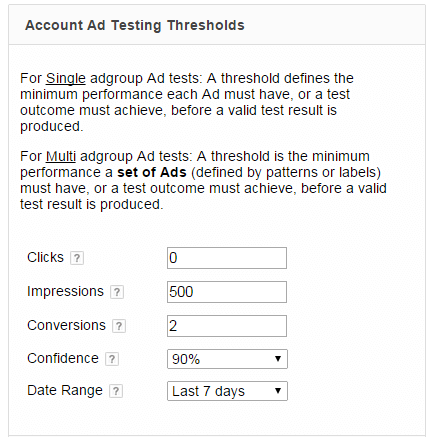
When testing ads, you often want to set minimum data requirements to make sure the test reaches statistical significance. This will vary by testing metric.
When considering conversion rate as your metric, think about:
- Clicks
- Impressions
- Conversions
With minimum data requirements, usually you want every ad in the test to reach the minimum numbers before you review the tests.
If you have an ad with a very low conversion rate, then it might take a long time for that test to hit minimum data since the ad rarely converts. This is why it doesn’t make sense to set a very high minimum on the number of conversions. In an extreme scenario, you could have two ads with the same number of impressions but one ad has 50 conversions and the other one has 2. If you use a minimum threshold of 10, that test wouldn’t be concluded before every ad hits the minimum thresholds.
Therefore, you might want to set your minimum conversions on the low side. Now, this is always tempered by how many conversions you get a day within an ad group. If you receive 1000 a day, then you can use higher minimums. If you receive 10 a month, then you’ll want lower ones.
CTRs are also a metric where a high minimum should be avoided. In fact, with conversion rate testing, minimum clicks are often not necessary to set at all. The exception is landing page tests, when you would want to set a threshold to ensure that each page did receive a minimum number of visits.
Impressions show how often an ad is displayed, regardless of its actual clicks and conversions. This is an important minimum, so each ad had enough chances to attract clicks and conversions before you end a test.
If you have a very high volume ad group, you might set this metric at 1000 per ad. If you have medium volume ad groups, then you might be OK with each ad only receiving 300 – 500 impressions. For low volume ad groups, it’s usually best to use multi-ad group testing instead of A/B testing.
Combining conversion rate with other metrics
There are many times that you’ll use two different metrics to determine a winning ad. What usually happens is one metric is a filter that is used to remove ads that cannot hit a certain threshold (such as CPA or ROAS) and the second one is used to determine a winner.
The primary metric used in conjunction with conversion rate is click through rate, creating a new metric known as CPI (conversion per impression). That metric has its own set of advantages and disadvantages, so we’ll examine that metric with its own article.
Some people will first filter ads by CPA and throw out the ads that are above their target CPA and then pick the highest conversion rate among those that are left in order to maximize conversions at or under a specific target CPA. We don’t recommend this since conversion rate doesn’t consider about volume of clicks (CTR). It’s a simple ratio of clicks you do receive to conversions.
Wrap-up
Conversion rate is a very important metric. However, since conversion rate doesn’t consider the ratio of clicks at all, it’s not a great metric to use for ad testing by itself. (It’s very good when combined with click through rate.)
The exception is when you are testing landing pages and not the ads. If your ads are identical and you are just testing landing pages, then conversion rate should be your primary testing metric.
Don’t discount conversion rate as a metric, but unless you are testing landing pages, don’t use it as your sole metric for determining ad winners.
If you’d like to easily see your conversion rates along with other testing metrics, take a look at what Adalysis has to offer. We also offer a 30-day free trial.
Share around the web









Improve performance
with
actionable
analysis



Leave a comment