Categories
Customer research can cost a lot, but your paid search campaigns already generate data that can help you understand which messages matter to your customers. Strategic ad testing turns that data into useful insights.
Start by listing out the questions you want to answer, such as:
- Are consumers price-sensitive? (Discounts, prices in ads)
- Does location matter? (Geographies in ads)
- Does shipping matter? (Free or rush shipping)
- Is selection important? (Large, exclusive, variety, etc.)
- How much does quality matter? (Cheap, luxury)
- What’s your best CTA? (Call, shop, find, discover, etc)
- Should we use our brand name in non-branded ad groups?
- Do we need to pre-qualify clicks? (B2B vs B2C)
Next, you need to determine how to test the question. For instance, if you want to know if consumers are price-sensitive (and to what extent), you can test:
- Ads with free shipping
- Ads with discounts
- Ads with prices
- Ads that don’t contain any of the above and focus on benefits and calls to action
If you want to know if location matters, then you test:
- Ads that contain locations
- Ads that don’t contain locations
None of these tests are that difficult to design – they just take a bit of thought. However, the setup and measurement can be complex.
Creating ads to test
Since you’re looking for insights across your customer base, you can’t just run a test in a single ad group. You need to run them across many ad groups and then look at the overall data. That means you need to be consistent with your setup.
For instance, let’s say we want to test price match guarantee versus free next day delivery. We would create two ads in an ad group, and since we want to ensure these lines are used, we would pin them to headline 2.
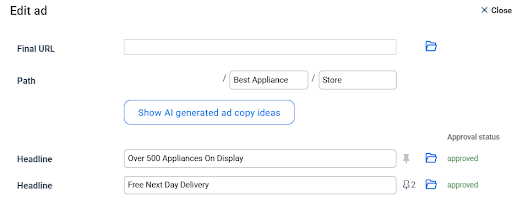
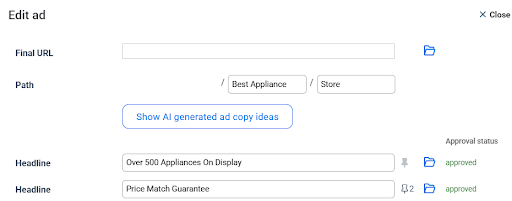
In some cases, you might want to test ads to see if you should use a call to action versus focusing on prices in your ads. You could create an ad and pin three CTAs to headline 2 in one of the ads. Then, create another ad and pin three headlines around pricing or discounts. Finally, replicate that experiment across all the ad groups you want to test.
To test geography in your ads, you might have one headline that contains the relevant location and another that doesn’t for each ad group.
The ad setup process can take a little while depending on how many ads you need to create, but the insights are worth the time.
Adalysis lets you create and update ads in bulk while automating test setup and management. It makes it easy to set up hundreds or thousands of ads in a single test.
The next step is measurement.
Measuring the test
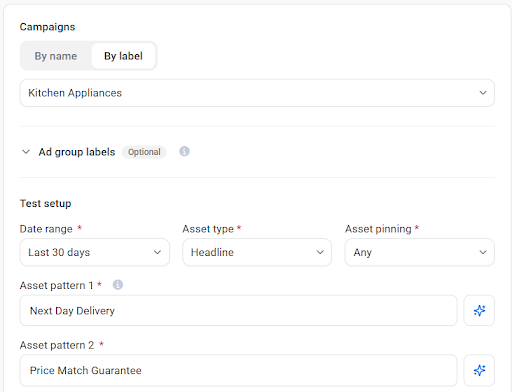
The next step is deciding how you want to measure the test. If your ad lines are very consistent, you can use pivot tables or software. If your lines vary a lot, or if you’re testing multiple lines, then you usually want to apply labels to the ads. That means you can combine the data at the ad label level.
In Adalysis, this is how we would set up the test:
The results
Finally, we want to see how each line performed. You can run this data with pivot tables or use software to automatically calculate it for you.
Here are the results for a similar test:
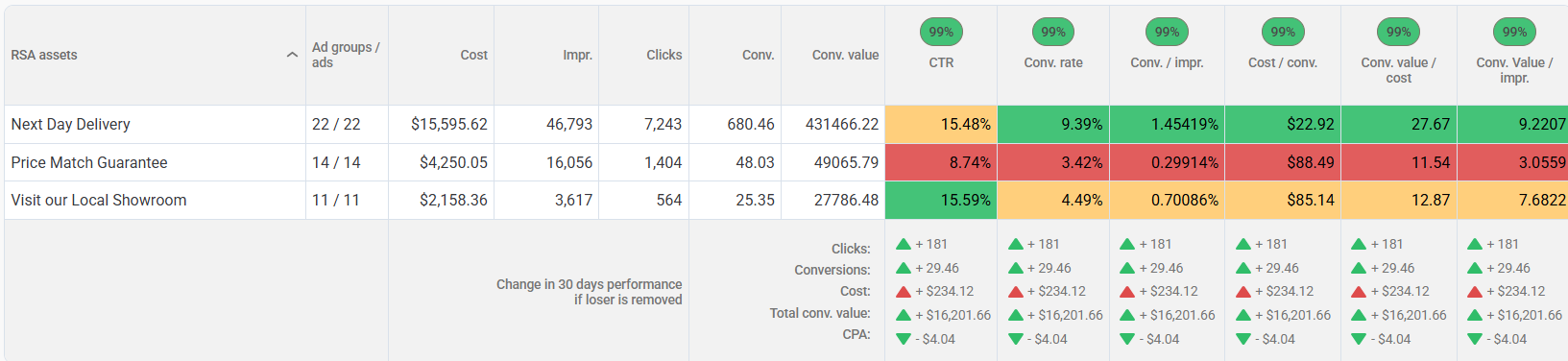
The highest CTR was a call to action to visit a local showroom. However, our best ad across every other metric mentioned next day delivery.
This tells us to focus on delivery. If we want people to visit our showroom, we could test a combination of these ideas. We could tell users that if they come to the store, we’ll deliver the next day for free.
We can also see that customers don’t care about price matching. If we didn’t have that line running for the past 30 days, we’d have generated another $16,201 in revenue. Clearly, we need to remove ads that mention price matching.
Another possible next step: in this case, the ‘best line’ only ran in 22 ad groups. We should expand the test to include more groups and make sure this theory is correct across the entire account.
If the test already covered the whole account, we could consider using this information to update our website. Then, it’s time to move on to the next test to gather even more insights from our customers.
Wrap-up
Getting insights from your regular PPC process means that you don’t need to spend time and resources on separate projects.
There’s value in third-party research and its deep customer insights. However, there are a lot of easy wins to be had just by testing ads in a strategic manner.
Adalysis makes large-scale ad testing easier to manage. Set up tests across multiple ad groups, combine the results, and get alerts when they reach statistical significance. Start with a 30-day free trial or book a demo.
Share around the web



Scale your PPC performance,
not your workload.


Leave a comment