Categories
Everyone’s using the same keywords (or broad match and AI Max), which essentially makes sure you and your competitors show up for the same search terms. Add Google’s automated bid technology on top of that, and where does your competitive advantage come from?
The answer is easy: your ads.
Ads have always been that connection point between your business and the searcher. Responsive search ads have so much amazing data that’s just totally overlooked. So today, we’re going to look at how you can get useful insights from this RSA data.
Insights you can test
Keyword insertion
In this example, the account uses a lot of keyword insertion. It recently went in-house after working with an agency, and the company wanted to know whether using keyword insertion was a good idea.

A double exclamation point means “does not include,” and an asterisk is a wildcard. So this test compares ads that don’t include keyword insertion with ads that do.
They’re used in the same number of ad groups, so it’s a good test even though they’re different ads. We can see that not using keyword insertion produces a better click-through rate, conversion rate, and so forth. It delivers much better results.
Price pinning in headlines
This company sells an expensive product, and they wanted to know whether to pin prices in headline 2 to prequalify users. So what happens when headlines contain a dollar sign, meaning they include prices, versus when they don’t?

This isn’t a fair ad test because it doesn’t have the same number of ad groups. But looking at the trend, the ads appear to perform better when they don’t use prices. Next, the advertiser needs to set up an official ad test with an equal number of ad groups.
Store locations vs. online
This next test is for a company with many locations. They wanted to know whether store locations or online shopping would perform better with their users.
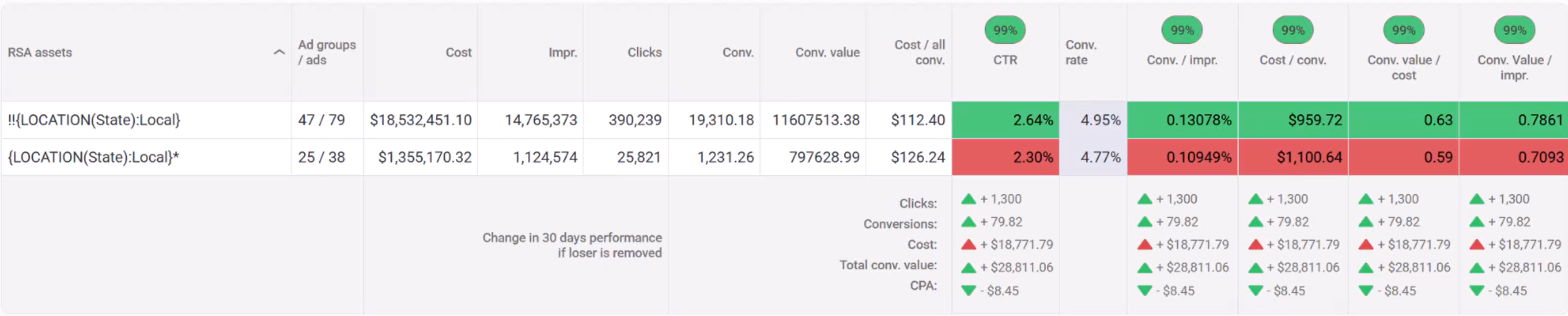
Again, this isn’t a fair test because the two versions are used in different numbers of ad groups. But overall, the data is better when the ads don’t mention locations. The company needs to reset the test slightly to see how the messages really compare.
Affordable vs. free quote
The next example is a B2B company. They wanted to know whether they should focus on offering an affordable product or a free quote.

This is often where we need to think about how we judge an ad test. The quote-focused message has a better click-through rate but a worse conversion rate.
When we have mixed metrics, such as CTR and conversion rate, we often turn to impression-based metrics to find the answer. On an impression basis, the winning message is the one that generates the most conversions.
These results aren’t statistically significant yet. But based on conversion value per impression, focusing on the quote is more effective than focusing on affordability.
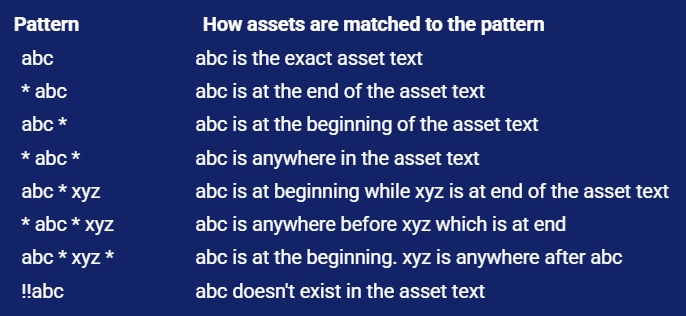
Here’s also a quick chart showing how to use wildcards in your ad tests:
More RSA test ideas
Should you mention your brand in non-brand ad groups? For some companies, the brand is so strong that this works very well. For others, it’s terrible.
Should you pin assets or leave them unpinned? That’s another common test.
You could also test whether to focus on prices, discounts, or ease of shopping.
You can’t get this type of information from a single ad group. Single ad group testing will find the best ad for that targeting method. But when we want messaging insights, we’re often looking across multiple ad groups.
Creating ads for testing
The first thing to decide is where to test. It’s usually better not to mix brand and non-brand. You may also have campaign labels that segment your different campaign types.
Even if you run a test across your entire account, you need to segment the results so you can get insights for each campaign type.
Setting up these tests is actually very easy. This workflow uses Adalysis ad management tools, but you could also do this in Google Ads or Google Ads Editor.
- Filter the campaigns we want to test, then select the ads and apply a label. If you start label names with “ad-”, you’ll know that they apply specifically to ads.
- Use the Adalysis tools to copy the ads with a different label. Now you have two identical sets of ads.
- Go to the RSA manager and filter by the first ad label. You can change the pinning, edit an asset, or delete assets in bulk.
- Switch to the second label and make the changes for the other version.
For example, if we wanted to test brand versus non-brand messaging, we could copy the ads and change one version to say “Official site for [brand]” or “Get your exclusive discounts at [brand].” If we wanted to test pinning, we could easily change the pinning for one ad set.
Setting up your RSA test
If you use Google Ads or Google Ads Editor, you’ll often need to aggregate the data using labels. It’s much harder to work with wildcards in Excel. With software like Adalysis, you can analyze patterns and wildcards directly.
You’ll need to specify which campaigns to include. If you’ve labeled your brand and non-brand campaigns, you can select each campaign type separately.
The second step is choosing the date range. How far do we want to look back?
Then we define the assets using patterns and wildcards. Then, are we testing headlines or descriptions? Are we testing pinning, or simply whether an asset appears in the ads?
Alternatively, we can look at the most-used assets. Based on the campaigns we’ve selected, Adalysis shows the metrics for each line. We can select the relevant assets and run the test.
Getting this type of insight is easy once you’ve thought about what you’re trying to accomplish.
Wrap-up
When everyone is using the same keywords, search terms, and AI technology, the difference is what your ads say.
How well do you understand your users? Are they interacting with your ads? Which messaging options are really the best?
If you have 15 headlines, four descriptions, and 10,000 impressions in an ad group each month, Google would take 47 years to reach statistical significance. And that’s assuming you want at least 100 impressions for each asset combination.
By aggregating the data, we can see results much faster and analyze them across large sets of targeting. This approach is more focused on insights than simply identifying the best ad for one targeting method.
Single ad group testing is still useful for brand campaigns and very high-volume ad groups. But when you want broader insights, or you have many smaller ad groups, aggregating the data can help you better understand your users.
That can give you an advantage over others in the market because ad testing is still highly underused.
Want to try Adalysis with your own ad data? You can choose between a free 30-day trial or a personalized demo call.
Share around the web



Scale your PPC performance,
not your workload.


Leave a comment